

An interior designer is one of the most useful collaborators on a Los Angeles remodel — and one of the most misunderstood. The title is unregulated in California, the scope overlaps with both architecture and general contracting, and the homeowner is usually the person paying for two professionals to coordinate cleanly. This post explains what a designer actually does on an LA residential project, how the role fits next to the licensed general contractor, and how a typical engagement is structured.
Designer, certified interior designer, and architect — what each title means in California
In California, anyone can call themselves an interior designer. The only state-recognized designation is Certified Interior Designer (CID), issued by the California Council for Interior Design Certification. A CID has met education and experience requirements, passed an exam, and is required by law to use a written contract for design services that lists scope, compensation, and certification number.
An architect or engineer is a separate, licensed professional whose stamp LADBS requires at plan check for projects that affect the structural shell — moving exterior walls, adding square footage, changing the roof line. A designer is not a substitute for an architect or engineer on those projects, and an architect or engineer is not a substitute for a designer on the finish, lighting, and selection work. On a typical LA remodel, the homeowner ends up working with all three — architect, designer, and licensed general contractor — each in their own lane.

What the designer actually delivers
A designer's deliverables on a Los Angeles residential project typically include:
- Concept and mood-board — the overall direction of the room, with reference imagery and material themes.
- Finish schedule — a single document listing every selected material, fixture, color, and finish, by room and by location.
- Lighting plan — fixture locations, switching, dimming, and Title 24-compliant luminaire selections.
- Plumbing and tile layouts — fixture locations, tile pattern direction, grout color, transitions.
- Cabinet shop drawings or selections — coordination with the cabinet shop on dimensions, hardware, and finish.
- Procurement and delivery coordination — long-lead items ordered to align with the construction sequence.
- Site visits during install and a final styling / punch list at the end.
The designer's job is to make every selection coherent with the existing architectural language of the home. A craftsman bungalow, a mid-century post-and-beam, a Spanish revival, and a hillside contemporary all want different materials, finishes, and lighting moves — even when the homeowner's wish list overlaps.
How the designer and the general contractor coordinate
On a well-run job, the designer and the general contractor are in steady communication from pre-construction through punch list. The designer hands off finish schedules, lighting plans, plumbing fixture spec sheets, and tile layouts; the contractor integrates them into the permit drawings, the build sequence, the trade scopes, and the inspection path. Where the designer specifies an unusual material — large-format porcelain slabs, a custom plaster finish, an integrated channel drain — the contractor scopes the trade work that supports it.
Decisions made early are cheaper than decisions made late. A tile direction selected during framing changes nothing on site; the same change after substrate is set can mean tear-out. The designer and contractor work to lock selections in the right window so the field crew is never waiting on a decision and never building over an unmade one.

Sample meetings happen at the home, not in a showroom
Designers typically bring physical samples — tile boards, fabric swatches, paint draw-downs, hardware samples, slab fragments — to the home rather than asking the homeowner to evaluate everything in a showroom. The reason is light. A tile that reads warm under showroom halogen can read cool under a north-facing LA window; a paint that looks neutral on a swatch can read green next to existing wood floors. Selections evaluated under the actual room light produce results the homeowner is happier with after install.

Title 24, lighting, and the parts of design that the code touches
California's Title 24 energy code shapes the lighting plan more than most homeowners expect, with efficiency requirements for permanent residential fixtures. The designer specifies fixtures that meet the code while still doing the architectural job; the contractor and the Title 24 consultant verify the plan clears review.
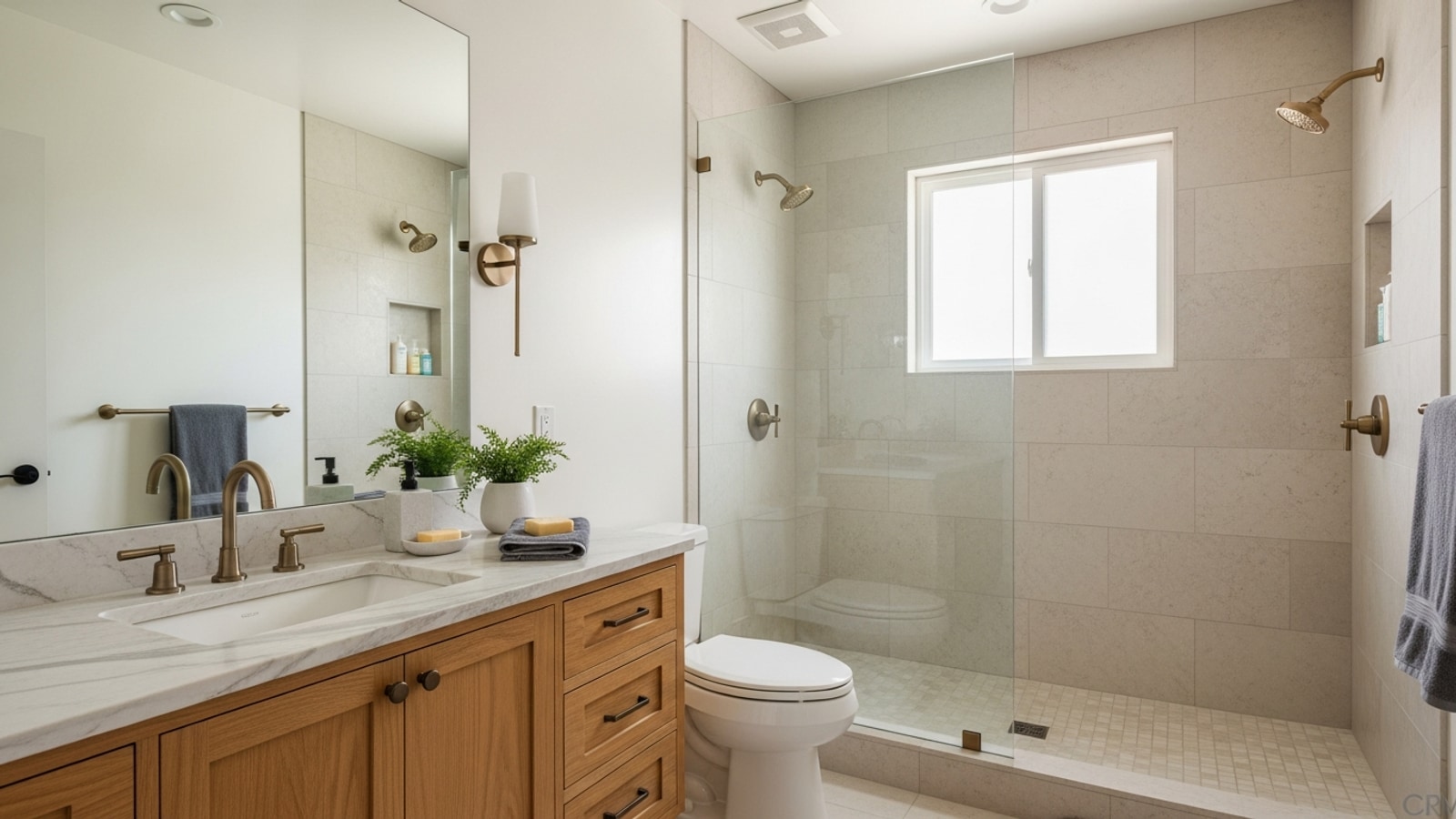
Lighting is also where the designer's selection work shows up most clearly in the finished room. Layered light — ambient, task, and accent — is what makes a remodeled kitchen, primary bath, or living room feel resolved instead of merely renovated.
How a typical engagement is structured
Most LA residential design engagements follow a similar arc:
- Discovery — site visit, conversation about how the home is actually used, photos and field measurements.
- Concept — direction and mood-board, narrowed selections, alignment with the architect's drawings if applicable.
- Construction documents and selections — finish schedule, lighting plan, plumbing and tile layouts, cabinet selections.
- Procurement — long-lead items ordered, deliveries coordinated to the contractor's schedule.
- Construction support — site visits at framing, pre-finish, and finish phases; field decisions documented.
- Styling and punch list — final selections in place, last items resolved, final walkthrough.
Some designers are full-service through styling; others hand off after construction documents. The contract spells out which phases are included.
FAQ
Do I need a designer if I already have an architect and a general contractor?
Not always. On a small remodel where selections are limited to two or three rooms and the homeowner has a strong sense of what they want, the architect and the contractor can carry the project. On a larger remodel — full kitchen, primary bath, lighting, paint, custom cabinetry — the designer typically more than pays for the work in avoided rework, coherent selections, and a finish that matches the home's architecture.
What's the difference between an interior designer and an interior decorator?
Decorators focus on furnishings, soft goods, and styling within an existing space. Designers extend into permanent selections — finishes, fixtures, lighting plans, layouts — that intersect the construction work. On a remodel, the designer is the role most owners need.
Should I hire the designer first or the contractor first?
Both work. Hiring the designer first gives you a finalized selection set before construction starts; hiring the contractor first gives you a feasibility check on the structure and the budget envelope before selections are made. Either way, the two work together once the project is under way.
Will the designer pick everything for me?
A designer narrows the field. Instead of an unbounded set of tile, fixture, paint, and cabinet options, the homeowner sees a curated set that fits the home, the architecture, and the direction of the project. The final call is still the homeowner's.